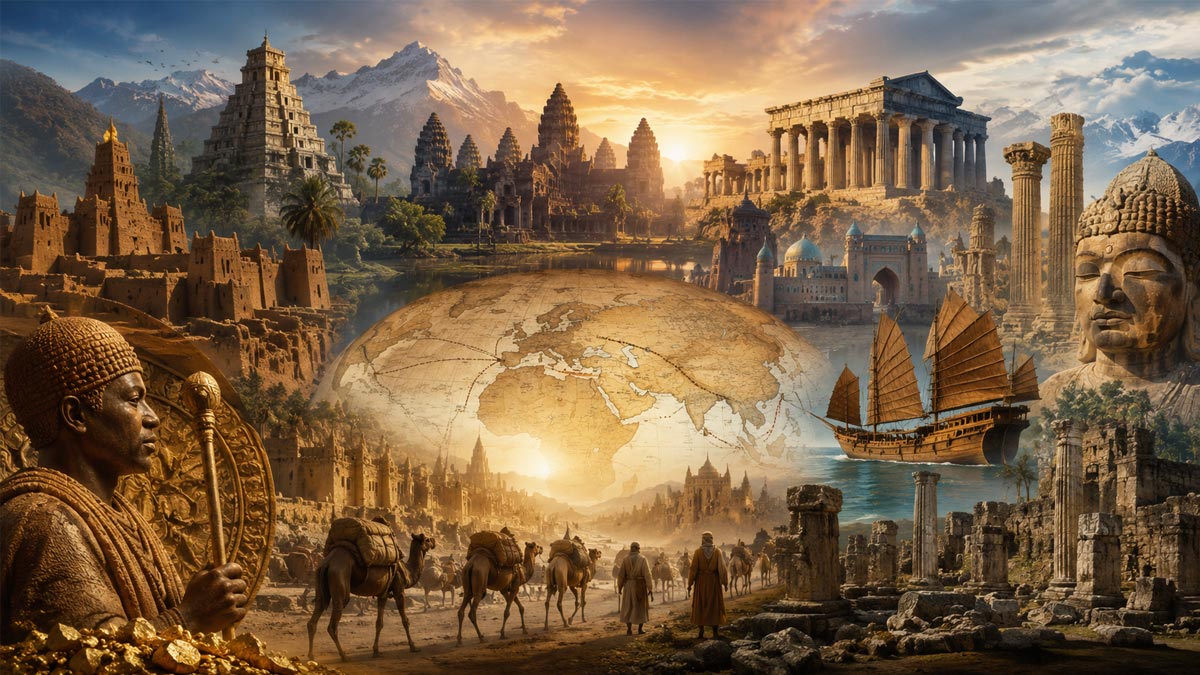
When people think about the greatest empires in history, the same names usually appear again and again: Rome, Ancient Egypt, the Mongol Empire, the British Empire, and perhaps the Ottoman Empire.
But history was never shaped by only the civilizations that dominate textbooks.
Across Africa, Asia, Europe, and the Americas, powerful empires rose, controlled vast territories, transformed trade, influenced religions, developed new technologies, and connected distant cultures. Some lasted for centuries. Others disappeared so completely that their achievements became little more than archaeological mysteries.
These are the forgotten empires that quietly changed the course of human history—without most people ever realizing how important they were.
The Aksumite Empire: The African Superpower That Connected Three Continents
Long before many European kingdoms became major powers, the Aksumite Empire was already one of the most influential civilizations in the ancient world.
Located in what is now Ethiopia and Eritrea, Aksum became a major trading power between Africa, Arabia, India, and the Mediterranean. Its strategic position near the Red Sea allowed it to control important trade routes connecting different parts of the ancient world.
At its height, Aksum was powerful enough to issue its own currency and maintain diplomatic and commercial relationships across enormous distances.
Perhaps even more surprising, Aksum was one of the earliest major states to officially adopt Christianity. This decision would have a lasting impact on the cultural and religious identity of the region for centuries.
Yet despite its influence, the Aksumite Empire is rarely mentioned alongside Rome or Persia.
The Sogdian City-States: The People Who Made the Silk Road Work
The Silk Road is often described as if it were a single route connecting China to Europe.
In reality, it was a massive network of trade routes—and one group of people played an especially important role in keeping that network alive.
The Sogdians.
Based primarily in Central Asia, Sogdian merchants became some of the most influential traders of the ancient world. They moved goods, languages, religions, and cultural ideas across thousands of kilometers.
Silk, spices, precious metals, art, and luxury goods traveled through their networks. But physical products were only part of their influence.
Buddhism, Christianity, Manichaeism, and other belief systems also spread across regions through the movement of merchants and travelers.
In many ways, the Sogdians helped create one of history’s earliest examples of globalization.
The Srivijaya Empire: The Maritime Power That Controlled Asian Trade
Centuries before modern Singapore became a global shipping hub, another Southeast Asian power understood the importance of controlling the sea.
The Srivijaya Empire emerged as a powerful maritime kingdom centered around the Indonesian archipelago.
Its influence was built on one simple advantage: geography.
By controlling strategic maritime routes, particularly around the Strait of Malacca, Srivijaya became deeply connected to trade between China, India, and the wider Indian Ocean world.
Ships carrying valuable goods often depended on these routes, turning the region into one of the most important economic crossroads in Asia.
Srivijaya was also a major center of Buddhist learning, attracting scholars and travelers from different parts of Asia.
Despite its enormous historical importance, many people today know almost nothing about the empire that once stood at the center of global maritime trade.
The Kushan Empire: The Civilization Between Rome, Persia, India, and China
Few empires occupied a more strategically important position than the Kushan Empire.
At its height, the Kushans controlled territories stretching across parts of Central Asia and the Indian subcontinent. Their location placed them between several major civilizations.
Rome lay to the west.
China lay to the east.
Persian powers dominated parts of the surrounding region.
India provided another enormous cultural and economic sphere.
The Kushans became a bridge between these worlds.
Trade flourished under their influence, but so did the exchange of artistic styles and religious ideas. The empire played an important role in the development and spread of Buddhism, particularly along routes leading toward Central and East Asia.
Art from the Kushan period also reveals something remarkable: a blending of Greek, Persian, Indian, and Central Asian influences.
It was a civilization built at the crossroads of the ancient world.
The Mali Empire: The African Kingdom That Shocked the Medieval World
The Mali Empire was far from forgotten during its own time.
In fact, one ruler became so famous that stories of his wealth spread across continents.
That ruler was Mansa Musa.
During his famous pilgrimage to Mecca in the 14th century, Mansa Musa traveled with an enormous entourage and vast quantities of gold. Accounts of his journey reached distant regions and helped establish Mali as one of the world’s most legendary sources of wealth.
But Mali was much more than a kingdom with gold.
Cities such as Timbuktu became important centers of scholarship, trade, and learning. Manuscripts covering subjects including law, science, religion, and literature circulated through intellectual networks.
For centuries, West Africa was deeply connected to international trade routes linking the continent with North Africa and the wider Islamic world.
The idea that medieval Africa was isolated from global history simply does not match the story of Mali.
The Hittite Empire: The Bronze Age Power That Disappeared
Before Greece and Rome became dominant forces, the ancient Near East was filled with powerful kingdoms competing for territory and influence.
One of the most important was the Hittite Empire.
Centered in Anatolia, in modern-day Turkey, the Hittites became one of the major powers of the Bronze Age.
They fought against ancient Egypt.
They developed sophisticated political systems.
They built powerful cities and maintained diplomatic relationships with neighboring civilizations.
One of history’s earliest surviving peace treaties emerged from the relationship between the Hittites and Egyptians following major conflict.
Then, like many civilizations of the Bronze Age, the Hittite world experienced collapse.
For centuries, the empire was almost completely forgotten.
It was only through archaeological discoveries and the deciphering of ancient texts that historians began reconstructing the story of this once-powerful civilization.
Imagine an empire large enough to challenge Egypt—then disappearing so thoroughly that later generations barely remembered it existed.
That is exactly what happened.
The Khmer Empire: The Civilization Behind Angkor
The Khmer Empire created one of the most extraordinary urban and architectural landscapes in human history.
Its most famous legacy is Angkor Wat.
But the temple complex is only one part of a much larger story.
At its height, the Khmer Empire controlled large areas of mainland Southeast Asia and developed an advanced system of reservoirs, canals, and water management.
The scale of Angkor was astonishing.
For centuries, it supported a massive population and became one of the most significant urban centers of the pre-modern world.
The empire’s engineers transformed the surrounding environment, building infrastructure that helped sustain agriculture and urban life.
Today, Angkor Wat attracts global attention.
Yet the empire that created it is often treated as little more than a mysterious background story.
Why Do Some Empires Become Famous While Others Are Forgotten?
History is not simply a list of the most powerful civilizations.
The civilizations we remember are often shaped by the survival of documents, the influence of later empires, colonial education systems, archaeological discoveries, and the stories that modern societies choose to repeat.
Rome became impossible to ignore partly because its political and cultural influence continued through later European history.
Other civilizations were less fortunate.
Their languages disappeared.
Their cities were abandoned.
Their archives were destroyed.
Their histories survived only through fragments written by outsiders.
Some were overshadowed by the empires that conquered them.
Others simply fell outside the traditional historical narratives taught in schools.
But forgotten does not mean unimportant.
The Hidden Lesson of Lost Empires
The story of history becomes far more interesting when we look beyond the civilizations everyone already knows.
The ancient world was not dominated by a handful of famous empires. It was a complex network of competing powers, trading societies, migrating populations, and cultural exchanges.
A merchant traveling through Central Asia could connect worlds that modern maps place thousands of kilometers apart.
A maritime empire in Southeast Asia could influence trade between China and India.
An African kingdom could become one of the world’s most important centers of wealth and learning.
An empire could challenge Egypt—and then vanish from collective memory for centuries.
Perhaps the biggest surprise is not that these forgotten empires existed.
It is that so many people still have no idea how much they shaped the world we live in today.
The history we know is only part of the story.
And somewhere beneath deserts, forests, modern cities, and forgotten ruins, there may still be entire chapters of human civilization waiting to be rediscovered.
Because sometimes, the empires that changed history the most are not the ones everyone remembers.
They are the ones we almost forgot.





Leave a Reply