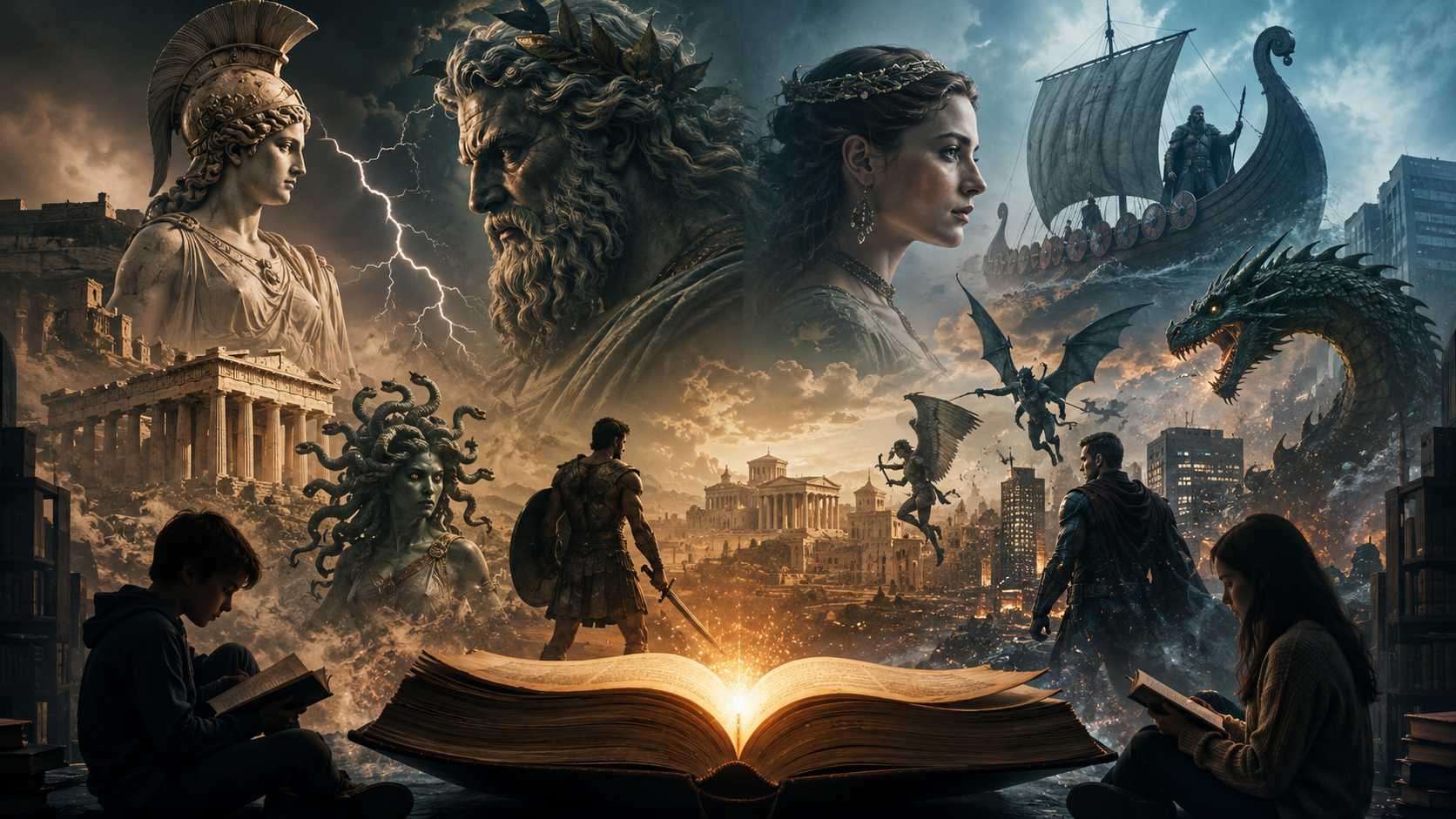
Ancient myths may have been created thousands of years ago, but their stories still appear everywhere in modern entertainment. From movies and fantasy novels to superheroes and popular television series, familiar ideas from Greek, Norse, Egyptian, and other mythological traditions continue to shape the stories audiences enjoy today.
What makes these myths so enduring is not simply their age. Many of them explore problems that remain familiar: ambition, jealousy, love, betrayal, sacrifice, identity, power, and the struggle between humans and forces greater than themselves.
Why Ancient Myths Still Feel Relevant
At first glance, an ancient myth can seem disconnected from modern life. The characters may be gods, monsters, heroes, or supernatural beings living in worlds very different from ours.
Yet the emotions behind their stories are surprisingly recognizable.
A hero may want to prove their worth. A ruler may become obsessed with power. Someone may struggle against a difficult destiny. A character may make a mistake that changes the lives of everyone around them.
These basic conflicts do not belong to a particular historical period. That makes mythology an incredibly flexible source of inspiration for modern writers and filmmakers.
Instead of copying an old story exactly, creators can take its central idea and place it in a completely different setting.
Mythology Has Become a Storytelling Blueprint
Many ancient myths follow recognizable patterns.
There is often a character who receives a difficult challenge, enters an unfamiliar world, faces dangerous obstacles, and returns transformed. Other stories focus on forbidden knowledge, tragic love, family conflict, revenge, or a struggle between order and chaos.
Modern storytelling frequently uses similar structures.
A fantasy novel might feature a young character discovering that they have a special destiny. A superhero movie might portray a powerful figure learning that strength comes with responsibility. A science-fiction story might explore humanity’s attempt to control technology that eventually becomes difficult to contain.
The details may be completely modern, but the underlying storytelling patterns can be surprisingly ancient.
Greek Mythology Has a Particularly Strong Influence
Greek mythology is one of the clearest examples of ancient stories continuing to influence modern entertainment.
Characters such as Zeus, Athena, Hades, Medusa, and Hercules remain widely recognizable. Their names and characteristics have been adapted into novels, films, games, comics, and television shows.
But modern creators often change these figures rather than simply retelling their original myths.
A character originally portrayed as a villain might become more sympathetic. A traditional hero might be given personal flaws. A familiar mythological world might be transformed into a contemporary setting.
This approach allows audiences to recognize something familiar while still experiencing a new story.
Norse Myths Have Found a New Audience
Norse mythology has also become increasingly visible in popular culture.
Figures such as Thor, Loki, Odin, and Valkyries have appeared in modern entertainment in forms that sometimes differ dramatically from their original stories.
Superhero adaptations are an obvious example. Modern versions of these characters combine elements of ancient mythology with comic-book storytelling, science fiction, action, and contemporary humor.
The result is not a historical reconstruction of Norse mythology. Instead, it is a reinterpretation.
That distinction matters because mythology has always evolved through retelling. Stories were passed from one generation to another, and each generation could emphasize different characters, values, and meanings.
Modern entertainment is continuing that process.
Ancient Monsters Keep Reappearing
Mythological creatures are another major source of inspiration.
Dragons, giants, sirens, centaurs, minotaurs, and other legendary beings appear repeatedly in fantasy fiction and film. Their physical appearances may change, but their symbolic roles often remain recognizable.
A dragon can represent danger, greed, power, or an obstacle that a hero must overcome.
A monster can represent something frightening that society does not understand.
A journey into a dangerous underground world can symbolize a character confronting their deepest fears.
This is one reason ancient creatures continue to work so well in modern stories. They can be entertaining on the surface while also carrying deeper meanings.
Modern Books Often Rebuild Old Stories
Authors frequently borrow ideas from mythology without directly announcing that they are doing so.
A novel may feature a character whose journey resembles that of an ancient hero. Another may reinterpret a famous myth from the perspective of a previously ignored character.
This approach has become especially interesting because modern writers can question the assumptions contained in older stories.
A character who was once treated as a villain can become the protagonist. A woman who appeared only briefly in an ancient tale can receive an entire story of her own. A familiar conflict can be examined from a completely different cultural or moral perspective.
In this way, modern literature does more than preserve mythology. It can challenge and reinterpret it.
The Hero’s Journey Remains Powerful
One of the most recognizable mythological patterns in modern storytelling is the hero’s journey.
The basic concept involves a character leaving an ordinary world, encountering challenges, receiving help, facing a major crisis, and eventually returning changed by the experience.
Not every modern story follows this structure exactly, but variations of it can be found across many genres.
Superhero films, fantasy adventures, science-fiction stories, and coming-of-age novels often use elements of this pattern because it naturally creates a sense of transformation.
The audience is not simply watching a character defeat an enemy. They are watching someone become a different person.
That emotional transformation is one of the strongest reasons mythological storytelling continues to work.
Mythology Also Influences Modern Villains
The influence of ancient myths is not limited to heroes.
Modern villains often resemble mythological figures who represent temptation, chaos, pride, revenge, or the misuse of power.
A character’s downfall may echo the ancient idea that excessive pride can eventually lead to destruction. A seemingly unbeatable antagonist may represent chaos threatening an established order.
These ideas are useful because they give fictional conflicts an emotional dimension.
The villain is not necessarily dangerous only because they are physically powerful. Their actions may represent a larger human weakness.
Why Audiences Enjoy Familiar Stories in New Forms
There is an interesting balance between familiarity and originality in mythology-inspired entertainment.
Audiences may recognize a character, creature, or story pattern without knowing every detail of the original myth. That familiarity can make a new story feel accessible.
At the same time, changing the setting, characters, relationships, or moral perspective creates something unexpected.
This combination helps explain why ancient mythology remains useful to modern creators. It provides a foundation without requiring the final story to remain identical to its source.
Mythology Is More Than Entertainment
The continued use of mythology also shows how people preserve cultural ideas.
Ancient stories often reflected questions about human behavior, nature, society, death, leadership, and morality. When those stories are adapted today, some of those questions remain visible.
Modern movies and books may not present myths as sacred traditions or historical explanations. Instead, they can turn them into ways of exploring contemporary concerns.
A story about an ancient god might become a discussion about power. A tale about a cursed hero might explore identity. A monster story might examine fear of outsiders or the consequences of human ambition.
The setting changes, but the questions remain.
The Future of Myth-Inspired Stories
As entertainment continues to evolve, ancient mythology is unlikely to disappear.
New technologies may change how stories are produced and experienced, but the fundamental themes that make myths powerful remain relevant. Audiences will still understand ambition, loss, love, fear, courage, betrayal, and the desire to discover who they really are.
Future creators may combine mythology with virtual worlds, interactive storytelling, animation, or entirely new genres.
The result may look very different from the myths people told thousands of years ago.
But the connection will remain.
Ancient mythology continues to influence modern movies and books because its most important stories are not really about gods, monsters, or legendary heroes. At their core, they are stories about people facing difficult choices and trying to understand their place in a complicated world.
That is a subject that never truly becomes ancient.


Leave a Reply