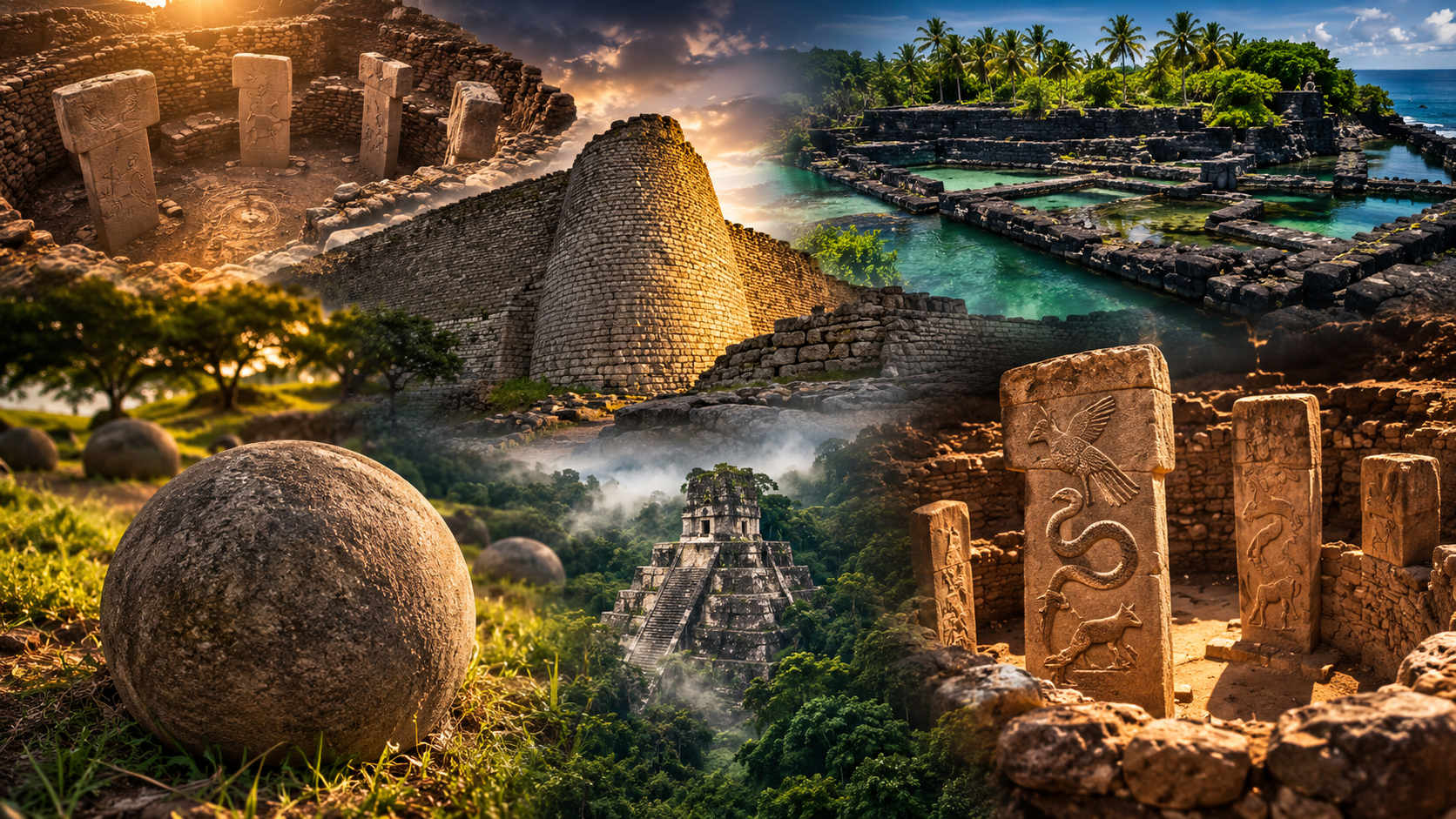
Across the world, ancient ruins continue to fascinate people not only because of their age, but because some of them leave behind puzzles that archaeology has not completely solved.
Stone structures, abandoned settlements, enormous monuments, and carefully designed underground spaces can reveal a great deal about the societies that built them. Yet in some cases, the evidence is incomplete. Researchers may know approximately when a site was constructed but still debate its original purpose, how its builders organized the work, or why the settlement was eventually abandoned.
These unanswered questions are part of what makes ancient ruins so compelling.
When the Evidence Tells Only Part of the Story
Archaeologists rarely discover an ancient site exactly as its builders left it. Centuries or thousands of years of erosion, earthquakes, looting, rebuilding, and natural changes can alter the original landscape.
Objects may also disappear. Wooden structures can decay, organic materials can be destroyed, and written records may never have existed.
As a result, researchers often have to reconstruct the past from fragments.
A stone foundation might indicate that a building once stood in a particular location, but it may not reveal exactly how the building was used. A collection of tools can provide clues about daily activities without explaining the broader purpose of the settlement.
This is why archaeological interpretations can change as new evidence emerges.
Göbekli Tepe and the Question of Purpose
Göbekli Tepe in modern-day Türkiye is one of the sites that has challenged assumptions about early human societies.
Its monumental stone structures were created thousands of years ago, featuring large T-shaped pillars decorated with animal imagery. The scale and organization involved in constructing the site are particularly striking.
One of the enduring questions concerns how these structures were used.
Researchers have proposed interpretations involving communal, ritual, or ceremonial activities, but understanding precisely how people interacted with the site remains an ongoing area of study.
The discovery has also contributed to broader discussions about the relationship between large communal projects, social organization, and the development of settled communities.
The Enigmatic Purpose of Stonehenge
Stonehenge is perhaps one of the world’s most recognizable prehistoric monuments.
Its massive stones were transported and arranged in a carefully planned landscape, demonstrating considerable knowledge of construction and organization.
But exactly why Stonehenge was built remains less certain.
Evidence suggests that the surrounding landscape had important ceremonial and funerary associations. The monument also has significant relationships with the movements of the Sun.
Still, knowing that astronomical alignments exist does not automatically explain the monument’s entire purpose.
It may have served several functions over different periods. Ancient monuments were not necessarily designed for a single purpose that remained unchanged for centuries.
The Abandoned City of Mohenjo-daro
Mohenjo-daro, part of the ancient Indus Valley Civilization, presents a different kind of mystery.
The city demonstrates sophisticated urban planning, including organized streets, drainage systems, buildings, and water-management features.
Its inhabitants clearly possessed considerable knowledge of city construction and infrastructure.
Yet the decline and eventual abandonment of major Indus Valley settlements remains a complex subject.
There is no single explanation that answers every question. Environmental changes, shifting rivers, economic transformations, and changes in settlement patterns have all been investigated as possible factors.
The mystery is not simply why one city disappeared. It is about understanding how an entire civilization changed over time.
The Underground World of Derinkuyu
Deep beneath Cappadocia lies Derinkuyu, an extensive underground settlement carved into volcanic rock.
The complex contains tunnels, rooms, ventilation shafts, storage areas, and other spaces designed to support people underground.
Its existence raises an obvious question: why would communities invest so much effort in creating such a difficult environment?
The answer appears to involve protection and temporary habitation, particularly during periods of danger. However, the exact history of the site’s development is more complicated.
Derinkuyu was not necessarily created all at once. Underground spaces could have been expanded, modified, and reused by different communities over long periods.
That makes the site a reminder that ancient structures can have multiple chapters in their history.
The Ruins of Great Zimbabwe
Great Zimbabwe in southern Africa demonstrates how much information can be hidden in monumental architecture.
The site contains enormous dry-stone walls and structures built without mortar. It was part of a sophisticated society that participated in regional and long-distance trade.
For a long time, however, racist colonial interpretations attempted to deny the achievements of African societies and attributed Great Zimbabwe to outsiders.
Modern archaeology has provided strong evidence that the monument was built by local African communities.
The remaining questions are therefore more productive ones: how did the settlement’s political and economic systems operate, how did its communities change, and what factors contributed to its decline?
The story of Great Zimbabwe shows that mysteries surrounding ruins can sometimes be created not only by missing evidence, but also by incorrect interpretations.
Why Ancient Ruins Continue to Puzzle Researchers
Mystery does not necessarily mean that archaeologists have no idea what happened.
In many cases, researchers understand a site’s chronology, architecture, materials, and cultural context remarkably well. What remains uncertain are the details.
There is an important distinction between “we don’t know” and “nobody can know.”
Archaeology is an evidence-based discipline. New excavations, scientific dating techniques, landscape analysis, DNA research, remote sensing, and improved interpretations of old discoveries can change our understanding.
A question that seems impossible today may become easier to answer when another piece of evidence is discovered.
The Most Interesting Mysteries May Have Ordinary Answers
Ancient ruins often inspire dramatic theories about lost civilizations, unknown technologies, or visitors from elsewhere.
But the real history can be more interesting than speculation.
Ancient people were capable of organizing large communities, moving enormous amounts of material, developing sophisticated engineering techniques, and adapting to difficult environments.
When evidence is incomplete, it can be tempting to fill the gaps with extraordinary explanations. Archaeology instead asks us to remain patient and distinguish between evidence, reasonable interpretation, and speculation.
That approach does not make ancient mysteries less fascinating.
It makes them more meaningful.
What These Ruins Can Still Teach Us
The unanswered questions surrounding ancient ruins reveal something important about human history.
Civilizations were not static. Communities changed, technologies evolved, environments shifted, and people repeatedly adapted to new circumstances.
Every excavation can therefore add another piece to a much larger story.
Some mysteries may eventually be solved. Others may remain uncertain because the evidence simply did not survive.
And perhaps that is part of the appeal.
Ancient ruins allow us to see what people left behind while reminding us of everything that has been lost. The stones may survive for thousands of years, but the complete stories behind them are often much harder to recover.




Leave a Reply