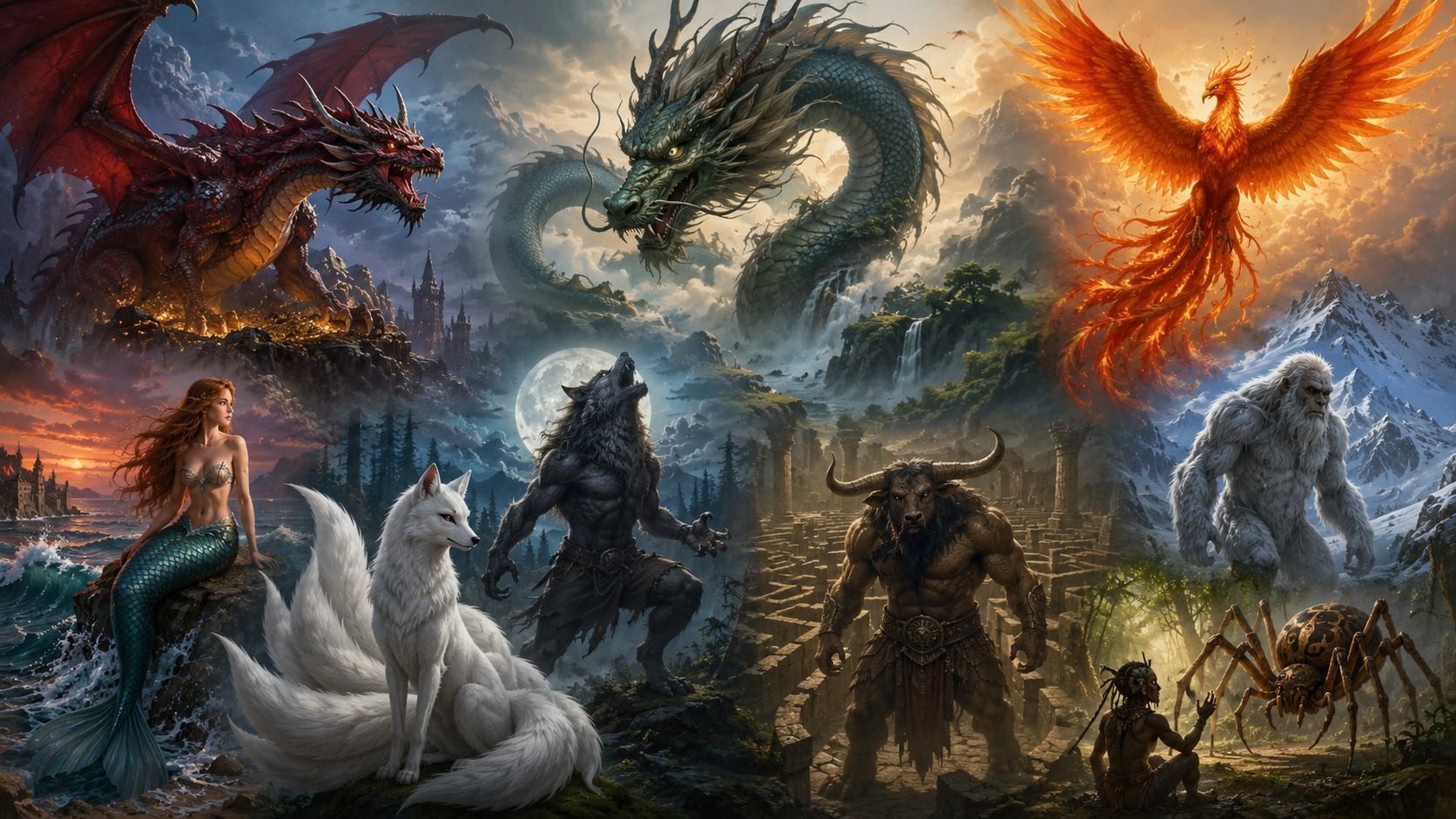
Across cultures and generations, people have filled their stories with creatures that seem impossible to exist in the real world. Some are terrifying monsters, while others are guardians, shapeshifters, or mysterious beings said to live beyond the boundaries of ordinary human life.
These mythical creatures are more than entertaining characters. They often reflect the fears, beliefs, environments, and values of the societies that created them. Even when two cultures have never interacted, their stories can sometimes feature surprisingly similar ideas: giant serpents, flying beasts, forest spirits, or creatures that protect sacred places.
Dragons: Powerful Creatures Found in Many Traditions
Few mythical creatures are as recognizable as the dragon. Stories about dragon-like beings appear across Europe and Asia, although their characteristics can be dramatically different.
In many European legends, dragons are portrayed as dangerous creatures with wings, sharp claws, and the ability to breathe fire. They often guard treasure or challenge heroes.
Asian traditions frequently present dragons in a different way. In Chinese mythology, for example, dragons have traditionally been associated with water, weather, power, and good fortune. Rather than simply representing evil, they can be respected supernatural beings connected to the natural world.
The contrast shows how the same basic creature can take on very different meanings depending on the culture telling the story.
The Phoenix and the Idea of Rebirth
The phoenix is another mythical creature that has captured people’s imagination for centuries. It is commonly described as a magnificent bird associated with fire and renewal.
The most famous version of the story says that the phoenix eventually dies and rises again, creating a powerful symbol of rebirth and transformation.
Stories of extraordinary birds appear in several ancient traditions, although the details vary. The enduring appeal of the phoenix may come from a simple human idea: the hope that something can begin again after destruction.
Mermaids and Mysterious Sea Creatures
The ocean has always been difficult for humans to understand completely. Before modern technology allowed people to explore the deep sea, vast portions of the world’s oceans remained mysterious.
It is therefore unsurprising that many cultures developed stories about strange beings living in or near the water.
Mermaids are often imagined as beings with a human upper body and a fish-like lower body. European folklore contains many stories about mermaids and related creatures, sometimes portraying them as beautiful but dangerous.
Other cultures have their own water spirits and supernatural beings that do not necessarily resemble the familiar Western mermaid. These stories often reflect the unpredictable nature of the sea and the dangers faced by coastal communities.
The Japanese Kitsune and the Art of Transformation
Japanese folklore includes the kitsune, a supernatural fox known for its intelligence and ability to transform.
Kitsune stories can be complicated because the creatures are not always simply good or evil. Some are mischievous, while others become helpful companions or spiritual figures.
The idea of an animal capable of taking human form reflects an old fascination with the boundary between humans and nature. It also gives storytellers a way to explore questions about identity, deception, trust, and appearance.
Werewolves and Fear of Losing Control
Stories about humans transforming into wolves or wolf-like creatures have appeared in European folklore for centuries.
The werewolf is particularly interesting because the creature begins as a human being. The transformation therefore creates a story about losing control over one’s own identity.
Different legends explain the transformation in different ways. Some connect it to curses, supernatural forces, or particular circumstances.
The popularity of the werewolf may partly come from its ability to represent a deeply human fear: what happens when the familiar person disappears and something uncontrollable takes over?
The Minotaur and the Monster Within
Ancient Greek mythology introduced the world to the Minotaur, a creature with the body of a man and the head of a bull.
According to the famous myth, the Minotaur lived inside the Labyrinth and was eventually confronted by Theseus.
The story is memorable not simply because of its monster, but because of the setting surrounding it. A maze, hidden chambers, and a creature that cannot easily be reached create a powerful metaphor for fear and uncertainty.
The Minotaur demonstrates how mythical creatures can represent more than physical danger. They can also embody psychological or symbolic challenges.
The Anansi Stories and a Different Kind of Mythical Creature
Not every mythical creature has to be enormous or frightening. In West African and Caribbean storytelling traditions, Anansi is a spider figure famous for his intelligence, cleverness, and ability to outsmart others.
Anansi stories often focus on wit rather than physical strength. The character can be selfish or mischievous, but his stories frequently teach lessons about intelligence, consequences, and human behavior.
This type of folklore reveals an important feature of mythical storytelling: supernatural characters can provide a safe way to examine very ordinary human problems.
The Yeti and Stories of the Unknown
The Yeti is traditionally associated with the Himalayan region and is often described as a large, human-like creature living in remote mountainous areas.
Whether viewed as folklore, cultural tradition, or a modern mystery, the Yeti represents a familiar storytelling pattern: the unknown creature hiding in a place that humans have not completely explored.
Remote mountains, dense forests, and other difficult environments have historically provided ideal settings for legends because they leave room for imagination.
Similar stories about mysterious wild humanoids have appeared in different parts of the world, demonstrating how isolated environments can inspire comparable folklore.
Why Do Similar Creatures Appear Around the World?
One of the most fascinating aspects of mythology is that different cultures sometimes create creatures with similar characteristics.
Humans everywhere experience certain universal fears and questions. People fear darkness, predators, storms, dangerous water, unfamiliar places, and the possibility of forces they cannot control.
At the same time, people are fascinated by transformation, immortality, hidden worlds, and the possibility that nature contains something beyond ordinary understanding.
This does not mean every mythical creature has the same origin. Each tradition developed within a specific historical and cultural context. But shared human experiences can help explain why certain themes appear repeatedly.
Mythical Creatures Reflect the People Who Tell Their Stories
A mythical creature can reveal a surprising amount about the culture behind it.
A dragon associated with rainfall and prosperity tells a different story from one guarding treasure. A clever trickster communicates different values from a monster designed purely to frighten people.
This is why mythology remains interesting even in an age dominated by science and technology. These creatures allow modern audiences to look backward and understand how earlier societies made sense of the world around them.
Why These Creatures Still Matter Today
Mythical creatures have never truly disappeared. They continue to appear in movies, television shows, books, video games, artwork, and popular culture.
But their role has changed. A creature once used to explain an unexplained natural phenomenon may now become a fantasy character. A terrifying monster can become a hero. An ancient spirit can be reimagined for a modern audience.
That flexibility is one reason mythology continues to survive.
The world’s mythical creatures may not exist in the way stories describe them, but the ideas behind them are very real. They represent curiosity, fear, hope, imagination, and the human desire to explain what lies beyond the familiar.
From dragons and phoenixes to kitsune, werewolves, and mysterious creatures of the mountains, these legends remind us that every culture has found its own imaginative way to explore the unknown.



Leave a Reply